“That’s more pine hoverflies than there are people”: Conservationists celebrate 30,000th release of rare invertebrate into Cairngorms National Park
Posted 20 Apr 2026
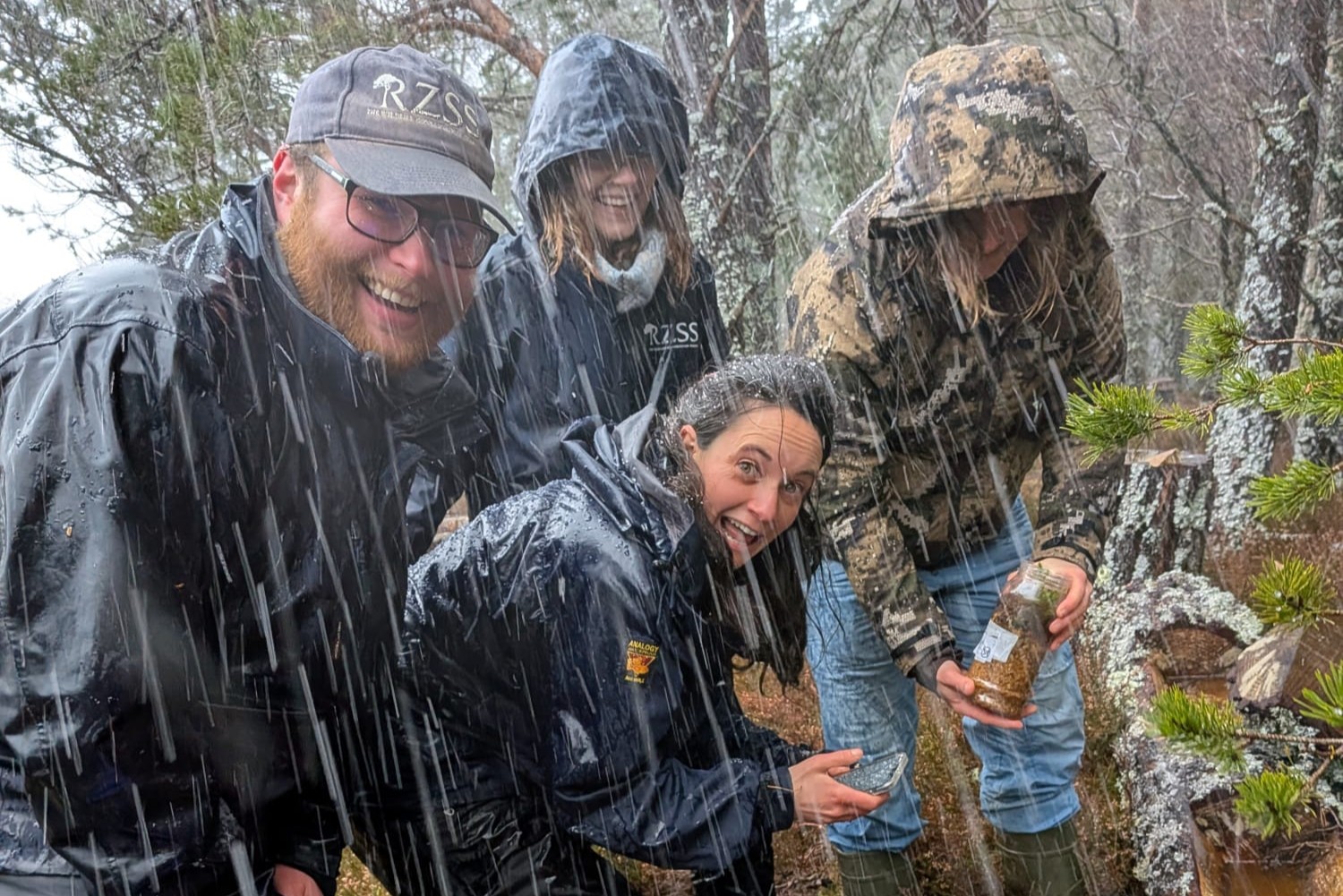
Conservationists at the Royal Zoological Society of Scotland (RZSS) have celebrated releasing the 30,000th pine hoverfly into the Cairngorms National Park as part of the breeding programme for the species. This milestone follows the wildlife conservation charity’s release of nearly 7,000 larvae across four sites in March 2026.
The pine hoverfly is one of Britain’s rarest insects and is Critically Endangered in Scotland. It depends on complex woodland habitats which were once widespread in the UK but are now restricted to a few sites within the Cairngorms.
The team braved high winds and hail for the landmark release, undertaken as part of the Rare Invertebrates in the Cairngorms (RIC) project and in collaboration with the Pine Hoverfly Steering Group.
RZSS field conservation manager Georgina Lindsay said: “The scale of our achievement really only struck me when we found out that 18,000 people live in the Cairngorms and we’ve now released almost twice as many flies!
“The reintroduction project is hugely important for the species, which is one of Britain’s rarest insects. This milestone is emblematic of so much hard work and dedication, and a tribute to collaborative work between organisations with a shared mission.”
Releases were conducted on land managed by the RSPB Scotland, Forestry and Land Scotland and Anagach Woods Trust.
RIC Project Officer Gen Tompkins said: “It’s fantastic to be celebrating this massive milestone. Alongside the large number of hoverflies released, it’s exciting that we are now starting to record more wild bred individuals at release sites and in new areas too.
“This would not be possible without a lot of hard work from project partners, volunteers and land managers restoring diverse and dynamic pine forests that include flowering trees and shrubs that pine hoverflies and other wildlife depend on.”
This project is supported by the Scottish Government’s Nature Restoration Fund, managed by NatureScot and the Scottish Government’s zoos and aquariums fund, and relies on critical funding from the Cairngorms National Park Authority, Forestry and Land Scotland, Marvelous Europe Inc., NatureScot, The National Geographic Society, Cheeky Panda, the John Swires Trust 1989 and players of the Postcode Lottery.